
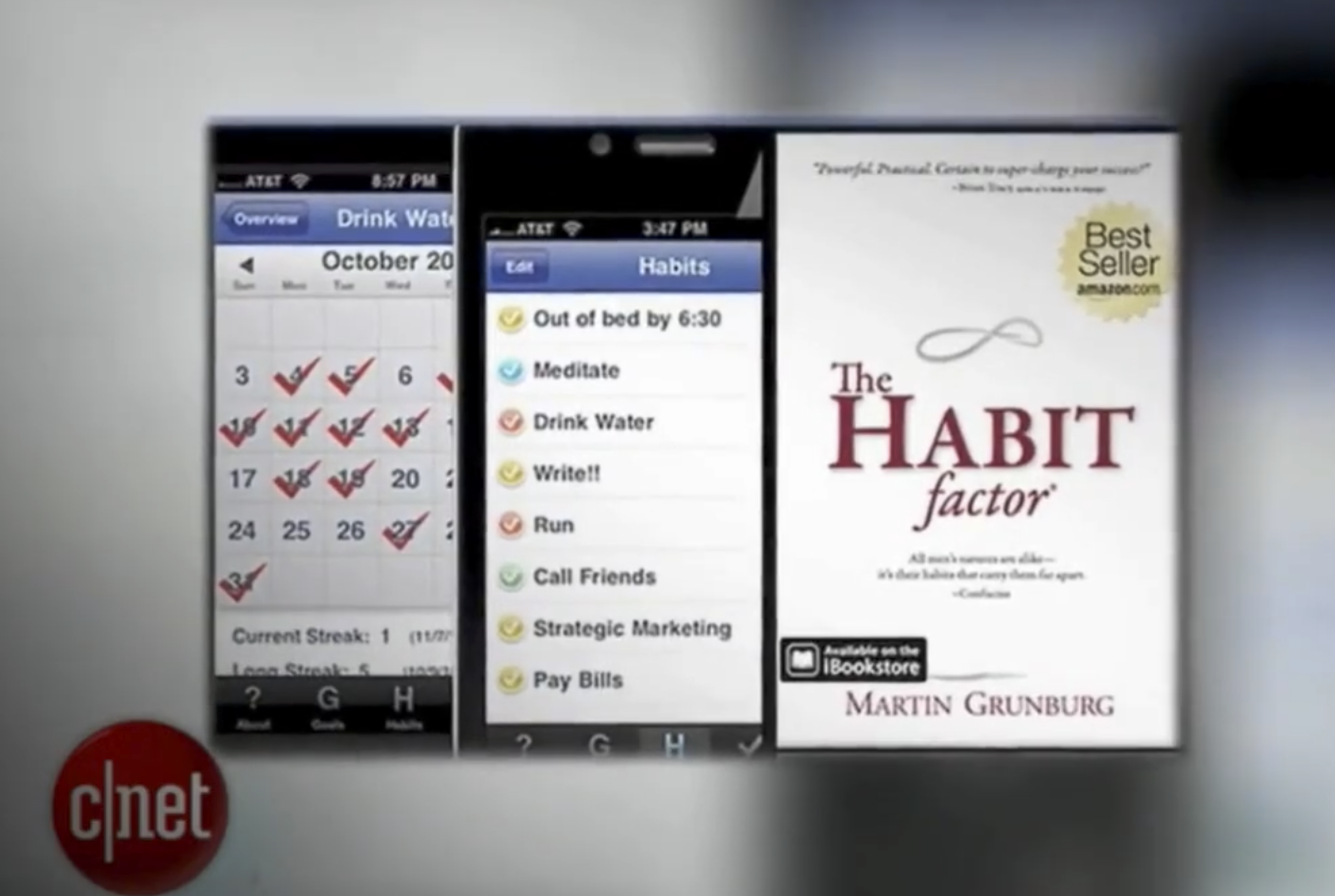
CNET Features Habit Tracking apps Including The Habit Factor® (2013)
How Behavioral Science Spent Sixteen Years Critiquing the Method Its Most-Cited Studies Quietly Depended On
SAN DIEGO, CA, UNITED STATES, May 7, 2026 /EINPresswire.com/ — Practitioner-Developed P.A.R.R. Methodology Predates What Behavioral Science Now Calls “One of the Most Replicated Findings”
Around 2015, behavioral science journals published a wave of papers questioning the efficacy of habit tracking. Researchers warned that tracking apps drove repetition but failed to build “real” habits. Measurement reduced enjoyment. Streaks and reminders created dependency rather than lasting behavior change.
By 2025, the field’s position had reversed. Psychology Today (December 2025) now describes self-monitoring as “one of the most replicated findings in behavioral science.” A 2024 systematic review reported a medium-to-large effect size for habit interventions.
The reversal raises the question. What changed? The answer appears to originate not in a scientific journal, but in the app store.
A Practitioner’s Experience
Not coincidentally predating all the academic critiques, in 2009 an app called, The Habit Factor® was published as the first habits-to-goals tracking app — a book by the same name followed in 2010. The premise: align habits to achieve goals more effectively. Through his own experience — and later through coaching others — author Martin Grunburg repeatedly observed the efficacy of the protocol he developed: P.A.R.R. — Plan. Act. Record. Reassess.
At the time, the cultural framing of “habit” was negative — smoking, drinking, nail-biting. Even coaches advised clients to avoid habits in pursuit of goals. The Habit Factor inverted the frame: a to-do list was helpful, but a habit list aligned with a goal was even more effective. As one CNET reporter put it in 2013: “This app distinguishes between goals and habits. Say your goal is to complete a marathon — it would make sense to develop the habit of running.”
The market responded. The Habit Factor® became a top-five productivity app across every major iTunes market. The book and app would lead to invitation to TEDx in the UAE. Mashable, Lifehacker, Sydney Morning Herald, The New York Times, even CNET all covered the methodology. Hundreds of habit apps and books would follow.
The Habit-Tracking Critique Evolves
Phase 1 (2015–2017): Stawarz, Cox & Blandford (UCL, 2015) reviewed 115 habit apps and concluded “reminders supported repetition but hindered habit development.” Etkin (Duke, 2016), in Journal of Consumer Research, reported that “measurement increases how much of an activity people do… [but] can simultaneously reduce how much people enjoy those activities.”
Phase 2 (2016–2020): Renfree, Harrison, Marshall, Stawarz & Cox (2016) studied the popular Lift app and concluded that streaks and reminders “create a dependency that introduces fragility.” The new position: tracking works, but creates dependency rather than “real” habit.
Phase 3 (2022–Present): Psychology Today (Dec 2025) declared self-monitoring “one of the most replicated findings in behavioral science.”
The experts missed what makes habit tracking effective — behavior itself is separate. That’s what makes it steerable.
Scaffolding, Not Dependency
Habit tracking operates like training wheels on a bicycle, sheet music on a piano, or a coach on the sideline — scaffolding, designed to be removed once automaticity develops. The critique that “behavior collapses if the app is removed too soon” is akin to saying “the rider falls if training wheels are removed too soon.” That’s not a flaw. That’s the method working as designed.
The Citation Paradox
The most striking irony lies in the field’s most-cited habit study. Lally et al. (2010) — source of the widely-cited 66-day rule — instructed 96 participants to choose a behavior, perform it daily, complete the Self-Report Habit Index (SRHI) each day, and record performance over 84 days.
That practice was P.A.R.R. dressed in academic clothing: Plan, Act, Record, Reassess. Thus, the same researchers questioning habit tracking were using it to produce the field’s canonical finding.
From Habit Tracking to Behavior Architecture
“To behave, by definition, is to choose,” Grunburg said. “I can go for a run or sit on the couch. Either way, behavior is both separate — selectable — and owned. Good habits happen when planned. Bad habits happen on their own.”
On July 8, 2025 — sixteen years after launching The Habit Factor® — Grunburg published (pre-print) the Unified Behavior Model™ (UBM), the first, elemental, unified, goal-directed and importantly falsifiable, framework in behavioral science. UBM directly address the field’s long-standing, nearly 150 year imperative for a unified frame. Ten months later UBM remains unfalsified.
Equilibrium Enterprises, Inc.
sales@equilibrium-ent.com
Gretchen Grunburg
Legal Disclaimer:
EIN Presswire provides this news content “as is” without warranty of any kind. We do not accept any responsibility or liability
for the accuracy, content, images, videos, licenses, completeness, legality, or reliability of the information contained in this
article. If you have any complaints or copyright issues related to this article, kindly contact the author above.

