
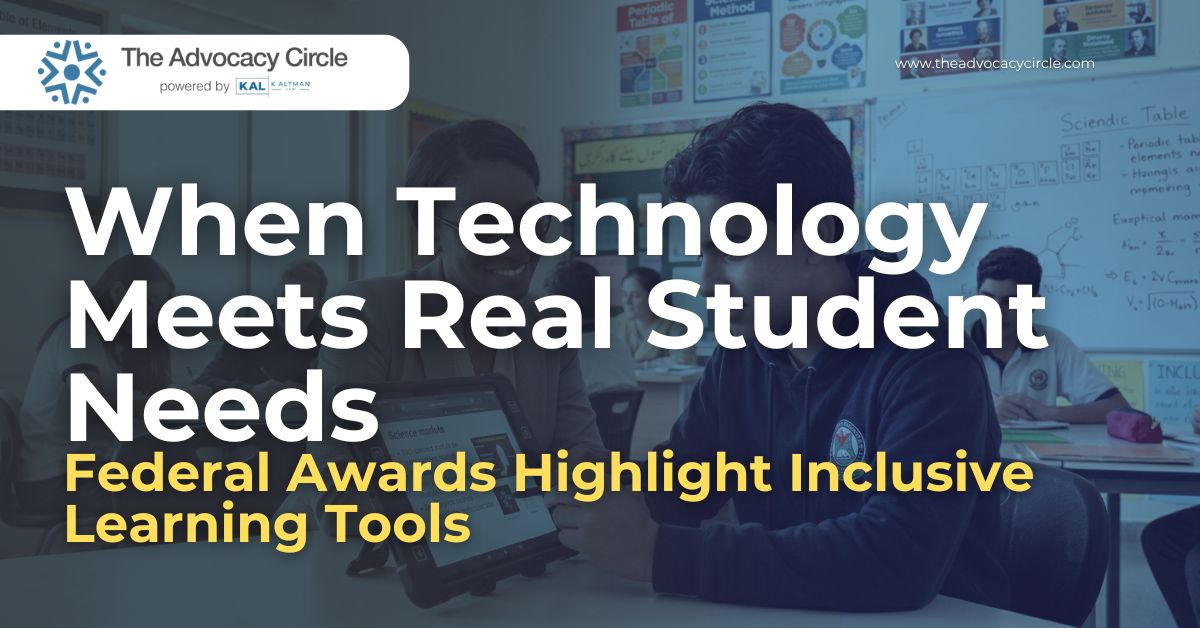
New federal EdTech awards emphasize tools designed to improve accessibility, engagement, and real-world support for students in special education.

Dan Rothfeld, Chief Operating Officer of The Advocacy Circle
New federal EdTech awards spotlight tools advancing accessibility, literacy, and real support in special education.
WASHINGTON, DC, UNITED STATES, April 30, 2026 /EINPresswire.com/ — Federal support for education technology innovation continues to offer a useful window into where the sector is headed, especially for students whose needs are too often underserved by one-size-fits-all systems.
The Institute of Education Sciences recently announced 2025 SBIR awards supporting the development and evaluation of technology products for education and special education. The funded projects include tools aimed at literacy, writing support, career readiness, and supports for students with learning disabilities and visual impairments. You can read more about it here.
For The Advocacy Circle, this is one of the more encouraging dimensions of the current EdTech landscape. Innovation is most meaningful when it addresses real barriers to access, communication, engagement, and support. That is especially true in special education, where tool design, usability, and implementation quality can significantly affect whether technology expands opportunity or simply adds complexity.
“Responsible EdTech innovation should be measured by whether it helps more students participate, communicate, and succeed,” said Dan Rothfeld, Co-Founder and COO of The Advocacy Circle. “When innovation is focused on literacy, disability access, and meaningful student support, it has the potential to align much more closely with mission-driven outcomes.”
The IES announcement also reinforces the value of evidence-minded development. Not every tool that promises personalization or efficiency will improve outcomes in practice. But when technologies are developed with evaluation, usability, and sustainability in mind, families, educators, and advocacy organizations have a stronger basis for asking which solutions are worth broader attention.
TAC believes the most important technology questions in special education often involve fit, implementation, and follow-through. Tools should help students access learning more fully, not shift responsibility away from the adults and systems meant to support them.
What educators and advocates should do now
● Ask whether a tool is designed for real classroom and student needs.
● Look for evidence, usability, and support structures, not only features.
● Evaluate whether disability access is built into product design.
● Consider how a tool affects educator workload and student experience.
● Focus on whether technology removes barriers in practice.
The Advocacy Circle helps families navigate special education and related school systems with practical tools, step-by-step guidance, and accessible support. TAC’s mission is to help parents prepare, communicate, and advocate with greater clarity and confidence before challenges escalate. Through expert-informed resources, community support, and technology-enabled guidance, TAC works to make advocacy more understandable, proactive, and accessible for families. www.theadvocacycircle.com
This content is provided for general informational purposes only and is not legal advice. Every student situation is fact-specific, and laws, policies, and procedures vary by state, district, school, and institution. Use of TAC resources or contact with TAC does not create an attorney-client relationship.
Dan Rothfeld
The Advocacy Circle
+1 947-366-0021
danrothfeld@theadvocacycircle.com
Visit us on social media:
LinkedIn
Instagram
Facebook
Legal Disclaimer:
EIN Presswire provides this news content “as is” without warranty of any kind. We do not accept any responsibility or liability
for the accuracy, content, images, videos, licenses, completeness, legality, or reliability of the information contained in this
article. If you have any complaints or copyright issues related to this article, kindly contact the author above.

