
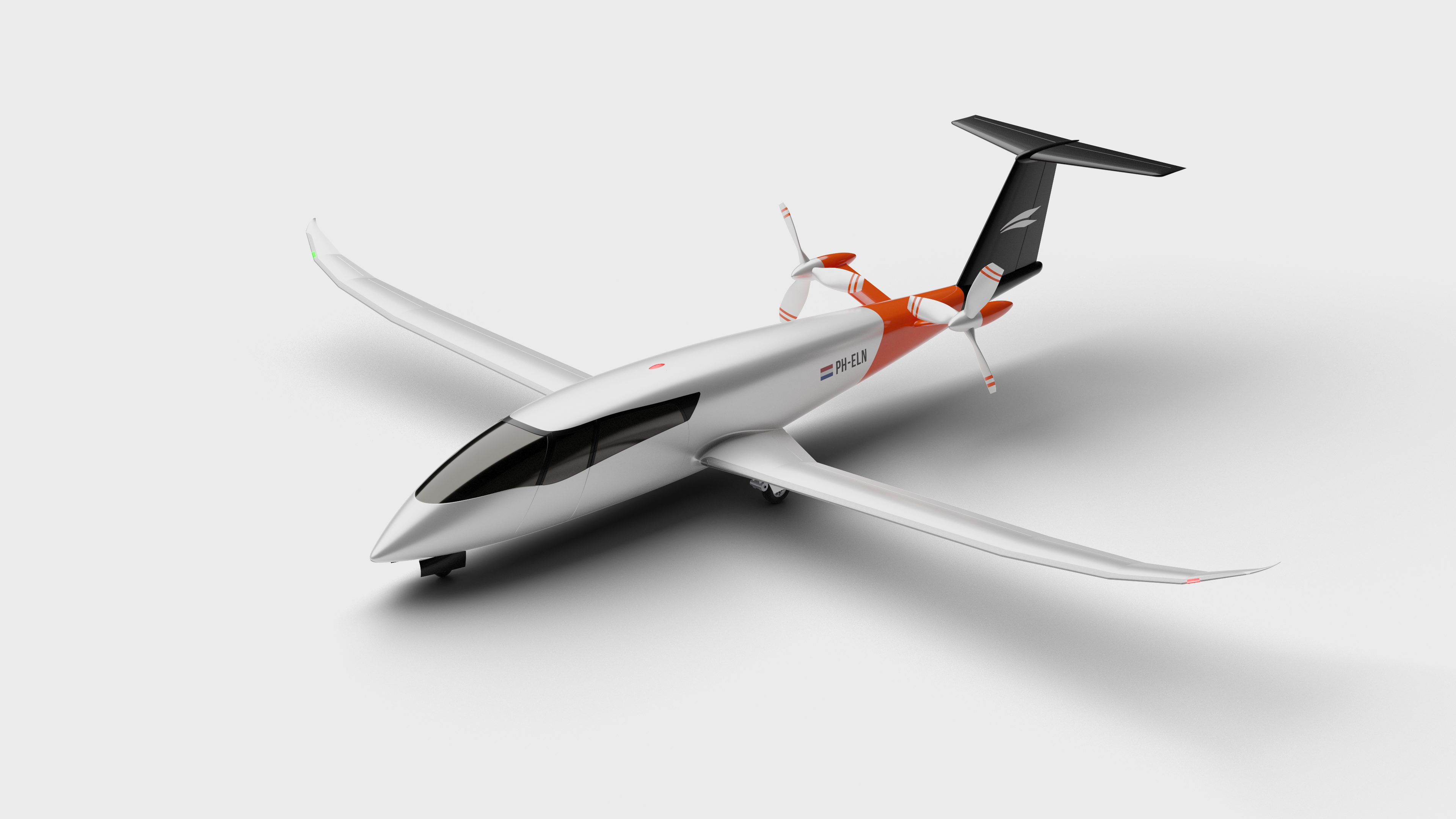
E5 aircraft parked white background
New aircraft achieves DCR approval with market leading payload and range targets using today’s battery technology
ROTTERDAM, NETHERLANDS, April 21, 2026 /EINPresswire.com/ — ELECTRON aerospace has reached a key milestone in developing the world’s first dual-motor electric aircraft by passing the Design Concept Review (DCR) for its five-seater battery-electric E5 aircraft. The review confirms that the selected concept meets the programme’s core payload and range requirements using today’s commercially available battery technology. The company today publicly revealed the revised aircraft concept for the first time at AERO Friedrichshafen that it is now building as a full-size flying prototype.
In simple terms, passing the DCR means ELECTRON has moved beyond an early concept and performance claim to an aircraft design backed up by real engineering work. The review confirmed that the selected concept can carry five people plus luggage, or 500 kg of payload, over 750 km using today’s batteries. By the time the plane enters into service in 2031, ELECTRON expects the E5 to offer a range of up to 1,000 km as battery energy density improves.
The DCR was carried out by an external review board to test whether the selected concept provides a credible basis for further development based on configuration, weight and performance assumptions and certification logic. In its conclusion, the board found that the programme had reached a high level of maturity for this stage and had progressed ahead of expectations. With that milestone behind it, ELECTRON is now sharing the selected concept publicly as the programme moves from concept validation into prototype build with first flight targeted by the end of 2027.
The selected concept reflects a deliberate simplification made before the DCR. ELECTRON moved away from an earlier canard configuration and chose a two-surface layout to keep the path to certification as straightforward and low-risk as possible. The team concluded that the canard added aerodynamic complexity and risked delays, without offering enough performance benefit to justify it.
“Passing the DCR shows we now have an aircraft concept that works for the mission and gives us a practical path into the next phase,” said Josef Mouris, Co-Founder and CEO of ELECTRON aerospace. “We have made deliberate design choices to keep the aircraft aerodynamically efficient, certifiable and buildable. That is how you turn an idea into a real aircraft programme.”
“Now is the right time to make the selected concept public, because the underlying assumptions have been validated and we are starting to build a full-size flying prototype,” said Marc-Henry de Jong, Co-Founder and CCO/COO of ELECTRON aerospace. “Now is the time when the programme becomes real for customers, partners and investors. In aerospace, seeing is believing.”
At this week’s AERO in Friedrichshafen, ELECTRON will share more detail on the aircraft architecture, mission profile and development roadmap. Alongside the concept reveal, the company will also present a functional cabin model, giving visitors the first opportunity to experience how easy the E5 is to enter and exit, and the generous cabin space it offers.
About ELECTRON aerospace
ELECTRON aerospace B.V. is a Dutch electric aircraft company developing the E5, a battery-electric five-seater aircraft designed for regional air mobility. The company is pursuing a pragmatic path to market by combining electric propulsion with an aircraft configuration inside an existing certification framework.
Media contact
Marc-Henry de Jong
Co-Founder & CCO/COO
marc-henry@flyelectron.eu
+44 7775 825605
www.flyelectron.eu
You can download the press release, renders, and logos here:
https://drive.google.com/drive/u/1/folders/1TTfKMnoK5kkf_1axEPFRa9o-Mlpjt3G3
Marc-Henry de Jong
ELECTRON aerospace B.V.
+44 7775 825605
email us here
Visit us on social media:
LinkedIn
Legal Disclaimer:
EIN Presswire provides this news content “as is” without warranty of any kind. We do not accept any responsibility or liability
for the accuracy, content, images, videos, licenses, completeness, legality, or reliability of the information contained in this
article. If you have any complaints or copyright issues related to this article, kindly contact the author above.

